
Canadian Bazaar
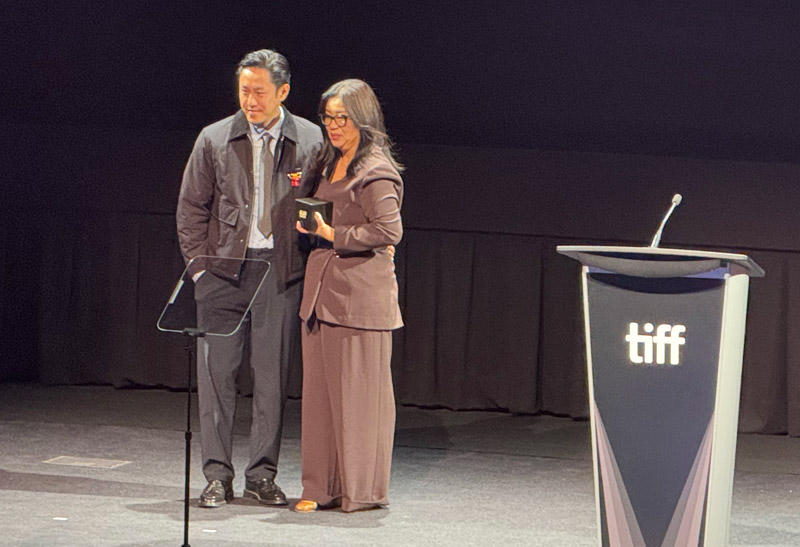
TORONTO: Angh, a lament for the disappearing tribal way of life with the arrival of Christianity missionaries and modernity in India’s Nagaland state, became the first-ever Indian film to win the prestigious Platform Award at the just concluded 51st Toronto International Film Festival (TIFF).
Naga film-maker Theja Rio’s debut movie now goes to compete for the Best International Feature Film at the Academy Awards.
Set in the sixties in the remote lush jungles of Nagaland, the film revolves around the only remaining tribal chief Anghba (Anghlong Konyak). He is the last hold-out against the onslaught of modernity coming in the wake of American missionaries.
In a way, the film is Theja’s insider’s take on the socio-cultural churnings in his society unleashed by alien influences, scaring his protagonist Anghba – called `old chief’ – with his ailing wife and son Amao (who never speaks a word) to cling to their identity even more fiercely.
Frame by frame, the film beautifully explores the unsettling social transformation through the eyes a deeply conflicted Naga tribal chief.
“Yes, I like to make films about things about which I am conflicted. I don’t like to make films about things I am sure about. Because if you make films about things you are sure about, then it can easily turn into something that is either propaganda or has an agenda,” said Theja after accepting the Platform Award at TIFF.
“First, it is a big deal to get your film to TIFF. Then to have it win the Platform Award is just another level. It has just happened and I trying to find the right words. I am overwhelmed,” said the 31-year-old Kohima-born film-maker who is a graduate from the National Film and Television School (NFTS) in London.
Himself a Christian, the young film-maker said he tried to maintain neutrality about the crisis triggered in his tribal Naga society by the missionaries and modernity.
“You know my family are Christian, I am Christian. But when I was writing this script, I tried to maintain a point of neutrality as much as possible.”
Did he make this film because he too is conflicted about his own identity in some manner?
“No, I won’t say I have any conflict with my faith. I think I have a balance (between his Christian faith and tribal identity) and I feel like more and more Naga people are learning to balance it a lot more,” said Theja.
“Of course, you know that with the arrival of Christianity a lot of our cultures were sort of diminished and that is the truth.”
Admitting that portraying these huge socio-cultural shifts in his society was a complex task, he said, “As much as the arrival of Christianity diminished our tribal cultures, it also brought a lot of peace to our region. You know, we were practising head hunting till, like, the last head hunting was recorded in the 1970s. These issues are so complex, there are so many pros and cons.
“So there is depth in equal measure on both sides in my film. There is depth on the protagonist’s side, and there is depth on the side people who converted to the other side (Christianity) and I am maintaining neutrality.”
Interestingly, all the cast in his film are non-actors.
“My cast are local people. They are non-actors. We did a week of workshop for them. That’s all. Then it took us a month to shoot this film in Nagaland and Delhi,” he said.
Actually, Angh is an expanded version of a short film Theja made in 2018-19. “That short film had a very good festival run and that gave me the confidence to expand it into a full-length film. So I have lived with this film for a very long time.”
Meenakshi Shedde, who as Senior Programme Advisor (South Asia) for TIFF was instrumental in bringing Angh to the Toronto festival, said, “The triumph of Angh is a very big honour for India. It is a historic milestone because I don’t know when an Indian film last won the Platform Award at TIFF. In 2023, Tarsem Singh’s Dear Jassi won the same award at TIFF, but he is US-based and had big studios behind him. But Angh is an indigenous film, so there is no industry (backing) to speak of. There are no trained actors, there is no studio, there is no infrastructure. In that sense, Theja’s achievements are way greater for the same award.”
Shedde said not a single Naga film has ever been released in a Naga theatre in India. “And then this man Theja comes along and shows up straight in a Toronto theatre at TIFF. So this a huge honour for India and South Asia.”
Indeed, when his Polish cinematographer Adam Pietkiewicz (he got the 2026 TIFF Tribute Variety Artisan Award) recorded the first shot of his film showing an apprehensive tribal chief watching the arrival of an American missionary (Douglas Henshall) on a boat, Theja had no clues about the future of his debut project.
But the TIFF award has put him on the global stage as Argh now heads to compete for an Oscar.
“We don’t know what the future brings, but for an Indian film – that too a Naga film in the Konyak (Naga dialect) language – to be at the door of such huge possibilities, is already a big achievement,” said Meenakashi Shedde.